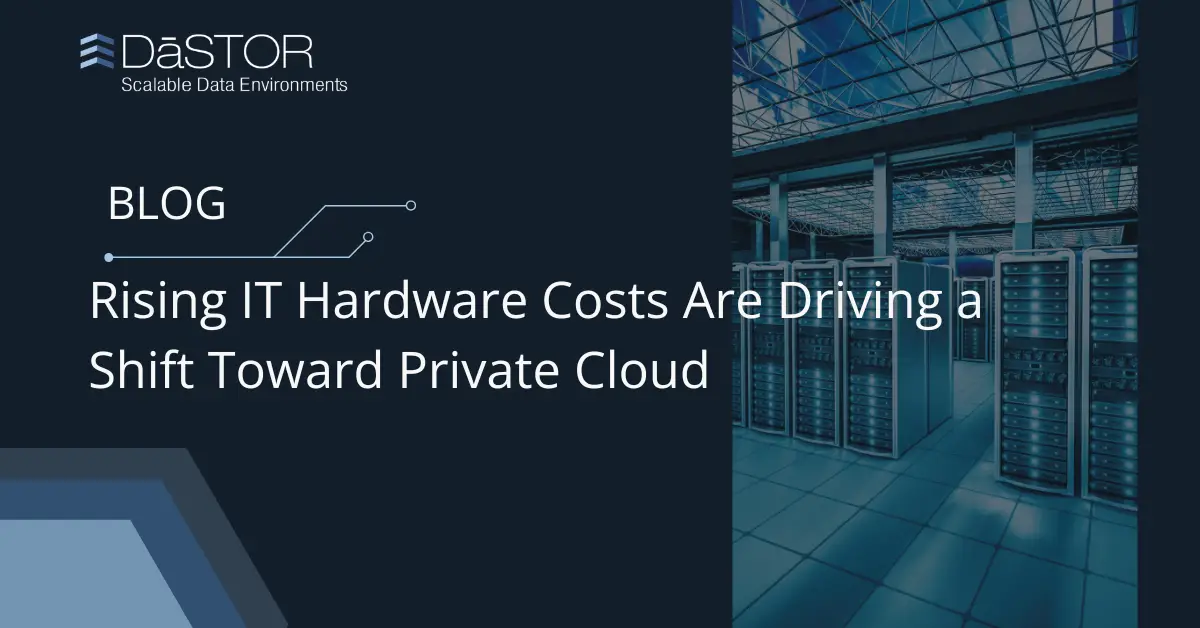
Enterprise IT planning has grown more complex as hardware costs continue to rise at an accelerated pace. What was once a relatively stable procurement process is now defined by frequent price changes, shortened quote validity periods, and growing uncertainty.
A major factor behind this shift is the rising cost of memory and storage components, which are being impacted by the hyperscalers’ global consumption of high-performance memory and storage. Industry reporting shows that memory pricing has surged significantly, in some cases doubling each quarter and representing a much larger share of total system costs. Much of this increase stems from supply constraints and increased demand tied to AI and high-performance computing workloads. As these pressures build, server pricing is also climbing, creating a ripple effect across enterprise infrastructure budgets.
This volatility is doing more than straining budgets. It is leading many organizations to delay projects and is forcing IT teams to reconsider how and when they invest in new infrastructure. According to reporting from TechRadar, server and infrastructure costs are continuing to rise due to supply constraints and increasing AI-driven demand, placing additional pressure on IT budgets and long-term planning.
The Limitations of Traditional CAPEX Models
The traditional model of purchasing and owning hardware relies on predictable pricing and long-term planning. Those assumptions are becoming harder to rely on as CAPEX costs increase rapidly, wreaking havoc on enterprise IT budgets. When hardware costs can increase 20-30% within a single month, committing to large capital expenditures introduces unnecessary financial risk.
Organizations are now facing not just higher upfront costs, but also greater uncertainty around long-term value. Infrastructure must still be maintained and managed, even as it may depreciate faster than expected. At the same time, long procurement cycles add further delays, especially as demand for compute capacity continues to grow.
These combined pressures are prompting a shift in thinking. Many enterprises are exploring more flexible approaches, including working with partners like DāSTOR to help reduce reliance on unpredictable hardware procurement cycles.
Private Cloud as a Strategic Alternative
Private cloud offers a different approach to infrastructure investment by shifting spending from capital expenditures to a more predictable operating model. Rather than navigating a volatile purchasing cycle, organizations can rely on infrastructure that is already in place and actively managed.
By shifting to an OPEX-based Private Cloud model, enterprises can avoid large upfront investments while still accessing a secure, private environment built with the same compute, storage, and networking resources they would have seen in their own data center. Plus, resources can be provisioned quickly, eliminating delays tied to hardware sourcing and delivery.
Equally important, private cloud provides a level of control and visibility that many organizations require. Unlike public cloud environments, where cost management and transparency can become complex, private cloud platforms provide clear, consistent insight into usage, performance, and spend. This allows IT teams to maintain accountability while adapting to changing business needs.
DāSTOR supports this model by delivering private cloud environments built on enterprise-grade infrastructure, giving organizations the ability to scale resources while maintaining performance and visibility.
Turning Market Pressure into Opportunity
Rising hardware costs are not simply a challenge. They are creating an opportunity for organizations to rethink how infrastructure is delivered and consumed.
Shifting to private cloud helps enterprises reduce exposure to pricing swings, better align costs with actual usage, and move faster on deployment. This is particularly important as businesses scale AI initiatives and data-intensive applications that require flexible, high-performance environments.
With secure, private cloud infrastructure already in place, DāSTOR enables organizations to bypass the delays and uncertainty associated with sourcing new hardware. Projects can move forward without being stalled by supply chain constraints or sudden pricing changes.
A Shift That Is Already Underway
The current hardware pricing environment is reinforcing a broader industry shift. Organizations are moving away from rigid ownership models and toward more flexible, consumption-based approaches to infrastructure.
Each organization will approach this transition differently, but the direction ahead remains clear: as costs continue to rise and procurement becomes more complex, private cloud is emerging as a practical and strategic solution.
The conversation for IT leaders is evolving. The focus is no longer limited to performance or capacity but now includes building an infrastructure strategy that can adapt to change, manage risk, and support long-term growth.